
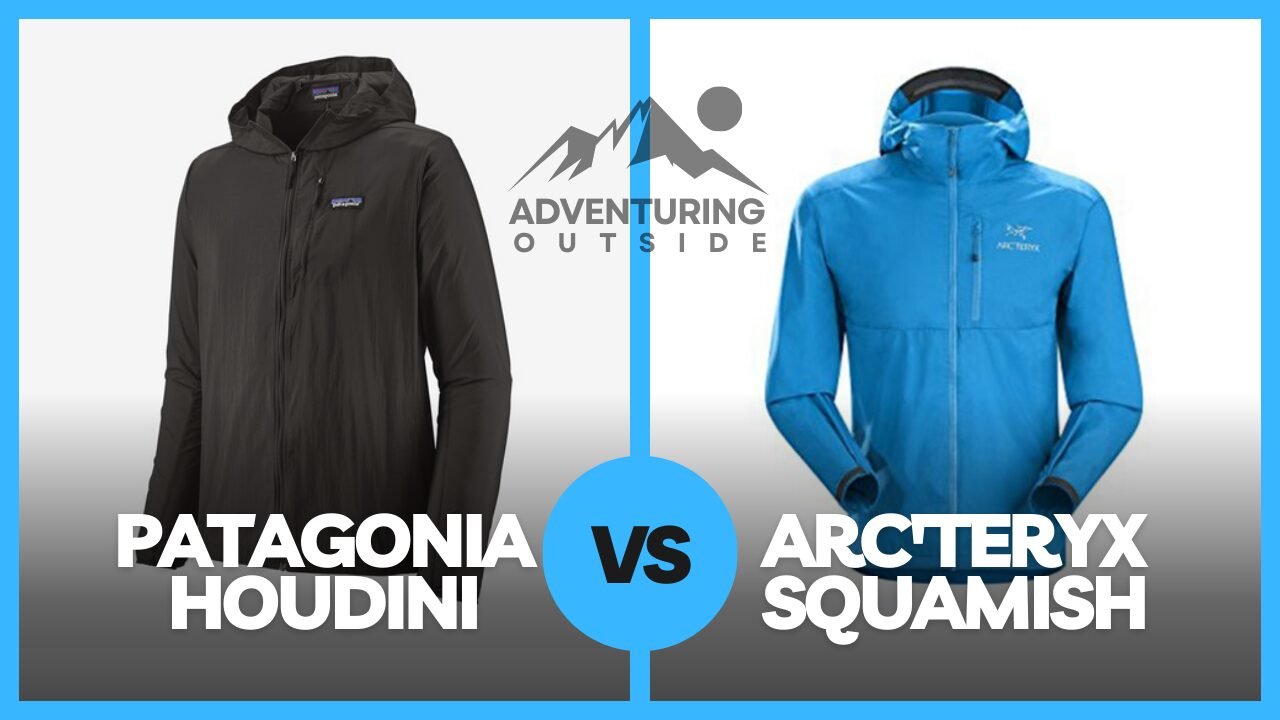
When considering a lightweight wind jacket, the Patagonia Houdini and the Arc’teryx Squamish are often at the forefront of the conversation. These jackets have crafted niches for themselves among outdoor enthusiasts and urban commuters alike. Their popularity stems from their successful blend of functionality and minimalism, making them go-to choices for those seeking reliable protection against the elements without the bulk.
Selecting between these two may come down to specific preferences and use cases. The Houdini, known for its ultra-lightweight design, has set a standard in the industry for portable weather-resistant gear. On the other hand, the Arc’teryx Squamish has been praised for its balance of comfort and durability, with updates to the model improving on its resistance to wind and light precipitation. With each jacket having its strengths, our comparison aims to dissect these nuances to aid in making an informed decision.
Key Takeaways
- The Patagonia Houdini and Arc’teryx Squamish are top competitors in lightweight wind jackets.
- The Houdini is ultra-light and packable, while the Squamish offers improved weather resistance and durability.
- Personal preference and activity demands will guide the choice between these two jackets.
Comparative Overview of Patagonia Houdini and Arc’teryx Squamish
When selecting a lightweight wind jacket, we often compare the Patagonia Houdini and the Arc’teryx Squamish. Both have distinct features suitable for outdoor activities, but they have their particular strengths.
Features:
- The Arc’teryx Squamish has undergone a significant revision in 2019, where its wind and water resistances were enhanced, and aesthetics were improved. The hoody now sports a trimmer fit and a more appealing look with the Iliad color being a favorite among many.
- Patagonia Houdini is known for its minimalism and functionality. It’s incredibly lightweight and can be easily packed down, making it a choice for those prioritizing portability.
Weight:
- Patagonia Houdini: Very light, making it ideal for quick trips or as an emergency layer.
- Arc’teryx Squamish: Slightly heavier than the Houdini, trading some packability for increased durability and features.
Price:
- Both jackets fall within a similar price bracket, with the Patagonia Houdini typically being slightly more affordable.
Breathability:
- Post-2019 versions of the Arc’teryx Squamish reportedly have decreased breathability.
- The Houdini maintains a reputation for sufficient breathability given its lightweight design.
Patagonia vs. Arc’teryx:
- Patagonia offers the Houdini with a focus on simplicity and ultra-light design, whereas Arc’teryx infuses the Squamish with robustness and a feature-rich approach.
To summarize in a table:
| Feature | Patagonia Houdini | Arc’teryx Squamish |
|---|---|---|
| Weight | Ultra-light | Light |
| Revised Version | No recent revision | 2019 revision |
| Breathability | Good | Moderate (post-revision) |
| Packability | Excellent | Good |
| Price | More affordable | Slightly higher |
We weigh these aspects carefully to determine which jacket aligns with our specific needs, whether we’re looking for a casual, lightweight jacket or something more resilient for the outdoor elements.
Design and Features
When we examine the Patagonia Houdini and the Arc’teryx Squamish, we prioritize functionality. The Houdini boasts a minimalist design, often favored for its ultralight construction. It features a single, chest pocket which doubles as a stuff sack, making it compact. A DWR (Durable Water Repellent) coating enhances its water resistance. The hood is simple yet functional, and the jacket utilizes a 100% ripstop nylon face fabric, providing adequate wind protection while maintaining breathability.
In contrast, the Squamish from Arc’teryx offers a more robust set of features. The first thing we notice is a zippered chest pocket, offering secure storage. Unlike the Houdini, the Squamish comes with hand pockets, adding to its practicality. Moreover, the hood design is meticulous, providing better coverage and adjustability. The Squamish also employs a ripstop fabric, but with an added focus on stretch and durability.
Both wind jackets incorporate adjustable cuffs, allowing us to alter the fit and seal against the elements. While they share similarities in their windbreaker capabilities, the Squamish provides slightly more breathable fabric than the Houdini’s latest version. As for the overall fit, the Squamish is designed with more room, contributing to its breathability without sacrificing wind resistance.
Each jacket carries distinctive qualities in design and features that cater to different preferences. We find that selection depends on the intended use, whether it’s for high-output activities or casual outings where storage and comfort may take precedence over weight.
Materials and Build Quality
When assessing the materials and build quality of the Patagonia Houdini and the Arc’teryx Squamish, it’s evident that both jackets are designed with a focus on durability and performance. The Patagonia Houdini typically utilizes a lightweight nylon ripstop fabric, enhancing its resistance to tears and abrasions. This choice of material contributes to the jacket’s longevity, making it a reliable option for our outdoor pursuits.
The Arc’teryx Squamish, on the other hand, often employs a more robust nylon material. Arc’teryx has been known to utilize Pertex® fabric in its designs, which offers a balance of lightness and strength. This fabric’s intrinsic qualities ensure the Squamish is both durable and comfortable, suitable for a variety of conditions.
Table 1: Fabric Comparison
| Feature | Patagonia Houdini | Arc’teryx Squamish |
|---|---|---|
| Material | Nylon Ripstop | Nylon (Pertex®) |
| Tear Resistance | High | High |
| Weather Resistant | Good | Better |
| Durability | Good | Excellent |
Both brands have established reputations for their commitment to quality. We find their stitching and seam construction to be precise and resilient, safeguarding against wear and tear. Further, they ensure that lightweight does not compromise protection by incorporating high-grade materials.
In summary, the Houdini and Squamish offer distinct qualities in their materials and construction. Patagonia’s Houdini favors simplicity and minimalism without forsaking robustness, while the Arc’teryx Squamish leans towards a more refined, enduring build, potentially at a slight increase in weight.
Fit and Comfort
When choosing between the Patagonia Houdini and the Arc’teryx Squamish, we must consider how the fit and comfort of these jackets align with our outdoor endeavors. The right jacket should offer a balance of wearability and adaptability to varying conditions without compromising on comfort.
Size and Wearability
The Patagonia Houdini is designed with a slim fit, conforming closer to the body which can be ideal for a streamlined look and less drag in windy conditions. It comfortably accommodates a t-shirt or a light baselayer underneath. In size M, most find that it offers a snug fit without being overly restrictive.
In contrast, the Arc’teryx Squamish offers what they term an athletic fit. This cut provides a bit more room which can be advantageous for additional layering. The fabric drapes nicely, allowing for free movement, making it a comfortable choice for a wide range of activities.
Layering Versatility
A key aspect of outdoor clothing is the ability to layer effectively. The Houdini’s slim profile makes it an excellent outer layer over a t-shirt or a thin baselayer but may be too snug for multiple or thick layers. While this may suffice for milder conditions, it limits the jacket’s versatility in colder weather.
On the other hand, the Arc’teryx Squamish’s athletic fit allows it to be more adaptable when it comes to layering. The additional space means we can wear it over a thicker mid-layer without sacrificing range of motion, making it a better option for cooler conditions or varied outdoor pursuits where adaptability is key.
Circular Hem and Cuff Adjustments
The Houdini’s cuff design employs a minimalistic approach, with elastic cuffs that provide a simple yet effective seal against the elements. This design choice reflects the jacket’s overall lightweight and fuss-free ethos.
Arc’teryx Squamish features Velcro cuffs, allowing us to tighten or loosen the fit according to our preference or the thickness of the layers we’re wearing beneath. This customizability paired with a circular hem that adjusts with a single pull cord, ensures we can fine-tune the fit to keep the wind and weather at bay.
Weather Protection Capabilities
When assessing the weather protection capabilities of the Patagonia Houdini and the Arc’teryx Squamish, we consider their water resistance and effectiveness as a shield against the elements.
Patagonia Houdini Jacket:
- The Houdini features a Durable Water Repellent (DWR) coating, offering a basic level of water resistance.
- It performs admirably as a wind jacket but is not classified as a rain jacket.
- For mist and light precipitation, it offers sufficient protection; however, in heavy rain, its capabilities are limited.
Arc’teryx Squamish Jacket:
- Following the 2019 update, the Squamish received improvements in both wind and water resistance.
- Its enhanced DWR coating allows it to repel water more efficiently than previous models.
- While it stands up better to adverse weather compared to the Houdini, it should not be mistaken for a full rain jacket.
Comparison Table:
| Feature | Patagonia Houdini | Arc’teryx Squamish |
|---|---|---|
| Water Resistance | Basic | Improved |
| Wind Protection | Excellent | Excellent |
| Breathability | Good | Moderate |
| DWR Coating Quality | Adequate | High |
We should note that the Houdini Air, a variant of the Houdini jacket, aims to strike a balance between air permeability and weather resistance, potentially offering a middle ground for those weighing breathability against protection.
In summary, both jackets provide competent weather protection suitable for a range of outdoor activities. However, neither should be relied upon during sustained downpours where a dedicated rain jacket would be more appropriate.
Performance in High Output Activities
When engaged in high output activities such as trail running, climbing, or mountaineering, the performance of our gear is critical. We place a premium on attributes like breathability and wind resistance, as they can greatly impact our comfort and performance.
Breathability and Temperature Regulation
Breathability is crucial in high output activities to prevent overheating and manage sweat. For example, while trail running or during intense mountain bike sessions, a lack of breathability could result in discomfort and distract from our activity.
- The Patagonia Houdini is recognized for its lighter weight and ability to pack down small, making it a suitable option for light hikes and urban use. However, the latest iterations post-2019 have seen some criticism regarding their breathability during strenuous activities.
- In contrast, the Arc’teryx Squamish, especially models from 2014 to 2018, has been praised for its breathability. The fabric choice and jacket design allow it to effectively let heat and moisture escape, which is beneficial for activities that involve constant movement and exertion.
Wind Resistance During Active Sports
Wind resistance is a vital element that can influence our body temperature and comfort, particularly in outdoor sports like climbing and mountaineering.
- The Houdini, with its minimal design, offers adequate protection against wind. Its compactness does not compromise its ability to shield us from gusty conditions, which is a cherished attribute when we’re high up on the rocks or moving fast on a trail.
- The Squamish Hoody steps up as a highly competent wind-resistant jacket. Its construction is focused on balancing breathability with wind-blocking capabilities. This combination is especially beneficial during mountaineering trips, where the weather can be unpredictable and wind chill is a significant factor.
Both jackets exhibit specific strengths in breathability and wind resistance, making them preferred choices depending on the type of high output activity we undertake.
Comparing Weight and Packability
When considering the Patagonia Houdini and the Arc’teryx Squamish jackets, we observe notable differences in weight and packability, essential factors for outdoor enthusiasts preferring minimalistic gear.
Weight:
The Patagonia Houdini boasts an impressively lightweight design. Weighing in at a mere 4.3 oz, it is one of the lightest wind jackets available. The Arc’teryx Squamish, on the other hand, is slightly heavier. The exact weight isn’t specified here, but the Squamish typically falls within a range that suggests a robust but still lightweight construction.
Packability:
Both jackets offer excellent packability; they can be compressed and stowed in their own pockets, making them exceptionally convenient to carry. Here’s how they compare:
- Patagonia Houdini: It packs down so small that it can fit into a pocket, transforming into a compact bundle that’s incredibly easy to slip into a backpack or even a waist pack.
- Arc’teryx Squamish: Similarly, the Squamish can be packed into its pocket for easy transportation, ensuring it occupies minimal space in your gear.
Given their design optimizations, both jackets serve as excellent options for anyone looking to maximize space efficiency. You’ll find that each jacket is fine-tuned for lightweight adventures, where every ounce counts and the ability to pack gear tightly is vital. Whether climbing a mountain or embarking on a long-distance trek, we value the blend of lightness and compactness that these jackets offer.
Assessing Value for Money
When comparing the Patagonia Houdini Air and the Arc’teryx Squamish, we must carefully consider the value for money of each wind shell jacket. Price is often a key determinant of value, but it’s not just about the tag; it also encompasses what you get for your money, such as the features and durability of the product.
The Squamish, after its 2019 revision, saw improvements in wind and water resistance, which may justify its typically higher price point. However, we must recognize that users have reported a decrease in breathability, which could detract from its value if you prioritize ventilation.
On the other hand, the Houdini Air, while generally less expensive than the Squamish, is praised for its lightweight design and compactness, making it a valuable item for those seeking a wind shell that won’t occupy much space in a backpack or under a harness.
Here’s a quick look at their value-adding features:
| Feature | Patagonia Houdini Air | Arc’teryx Squamish |
|---|---|---|
| Price | Generally less expensive | Typically more expensive |
| Breathability | Good | Reduced post-2019 update |
| Packability | Excellently compact | Reasonably compact |
| Wind/Water Resistant | Capable | Improved resistance |
In terms of features, the Squamish excels with the tangible enhancements it has received, while the Houdini Air is a strong contender in portability and breathability. Each jacket brings a unique set of qualities that, depending on one’s individual needs, can represent more or less value. We consider these factors crucial in deciding which jacket offers the best value for your investment.
Final Thoughts and Recommendations
When considering the options for a reliable wind jacket, our careful analysis leads us to appreciate the distinct qualities of both the Patagonia Houdini and the Arc’teryx Squamish Hoody.
The Patagonia Houdini shines in lightweight convenience and is ideal for activities where every ounce counts. Its ability to pack down small makes it an excellent companion for runners and light hikers.
- Compactness: Packs down, saving space
- Weight: Feather-light for minimalists
In contrast, the Arc’teryx Squamish Hoody, updated in 2019, provides enhanced wind and water resistance. Its tailored fit and aesthetic appeal make it a versatile choice that transitions smoothly from outdoor adventures to casual urban wear.
- Resistance: Improved protection against elements
- Versatility: From trails to streets
As for the Outdoor Research Helium Wind Hoodie, it stands as a solid competitor. Boasting its own feature set and durability, it merits consideration for those seeking balance between performance and comfort.
When recommending a wind jacket, we assess the specific needs of the user. For those prioritizing minimal bulk and weight, we suggest the Patagonia Houdini. However, for individuals seeking an all-rounder with superior protection and style, the Arc’teryx Squamish is our recommendation. Buyers seeking a middle ground with strong all-around capabilities might find the Outdoor Research Helium Wind Hoodie to be the perfect fit.
Frequently Asked Questions
In our exploration of the Patagonia Houdini and the Arc’teryx Squamish, we understand that specific aspects like wind resistance, breathability, suitability for various activities, durability, layering, and fit are crucial factors for outdoor enthusiasts making a decision. Here, we address common queries to help distinguish between these two popular jackets.
What are the key differences in wind resistance between the Patagonia Houdini and the Arc’teryx Squamish?
The Patagonia Houdini is known for its strong wind resistance despite being ultra-lightweight. The Arc’teryx Squamish, especially after its 2019 revision, also offers improved wind resistance while maintaining a balance with breathability.
How does the breathability of the Patagonia Houdini compare to the Arc’teryx Squamish?
While the Patagonia Houdini is breathable, the Arc’teryx Squamish is noted for its slightly better breathability, though this was reduced somewhat with the 2019 revision. The trade-off lies between more robust wind protection and the breathability level each wearer needs.
Can the Patagonia Houdini or the Arc’teryx Squamish be considered better for trail running?
For trail running, the Patagonia Houdini is often preferred due to its lighter weight and compact design. However, personal preference for fit and breathability may lead some to choose the Squamish.
Which jacket offers better durability and long-term performance, the Patagonia Houdini or the Arc’teryx Squamish?
Both jackets are built for performance, but the Arc’teryx Squamish typically edges out in durability due to its construction. Users should consider their level of use and the type of wear-and-tear for an informed decision.
Is the Patagonia Houdini or the Arc’teryx Squamish more suitable for layering in variable weather conditions?
The Patagonia Houdini’s compact and lightweight design makes it a versatile option for layering. The Arc’teryx Squamish, with its roomier fit, also lends itself well to layering, potentially offering more warmth due to the added space for insulation.
How do the fit and sizing between the Patagonia Houdini and the Arc’teryx Squamish compare?
The Patagonia Houdini generally offers a slimmer fit, appealing to those seeking a closer-fitting jacket. The Arc’teryx Squamish, post its revision, has a bit more breathing room, which may be preferred for a more relaxed fit or increased layering options.
